Yes, the current version of EndpointLock™ for Mac is fully compatible with macOS 10.14 (Mojave). If an update for EndpointLock™ is available for your system, you will receive a notification from the EndpointLock™ application upon restarting it. Apr 24, 2020 Mac Pro introduced in 2013, plus mid-2010 or mid-2012 models with a recommended Metal-capable graphics card. To find your Mac model, memory, storage space, and macOS version, choose About This Mac from the Apple menu. If your Mac isn't compatible with macOS Mojave, the installer will let you know.
- Enable Access For Assistive Devices Mac Mojave 2
- Assistive Devices For Reaching
- Enable Access For Assistive Devices Mac Mojave 2017
| Click here to return to the 'Enable and disable Assistive Devices via Terminal' hint |

---
-J-
Enable Access For Assistive Devices Mac Mojave 2
tell application 'System Events'
set UI elements enabled to true
end tell
The user will get prompted to enter their credentials. No need to use the do shell script.
So, to be safe, it appears it would be better to: ...instead.
Argh - submitted too soon...Almost correct: The file should NOT contain the trailing newline. So, that means it should be: (with the extra '-n' switch passed to echo)
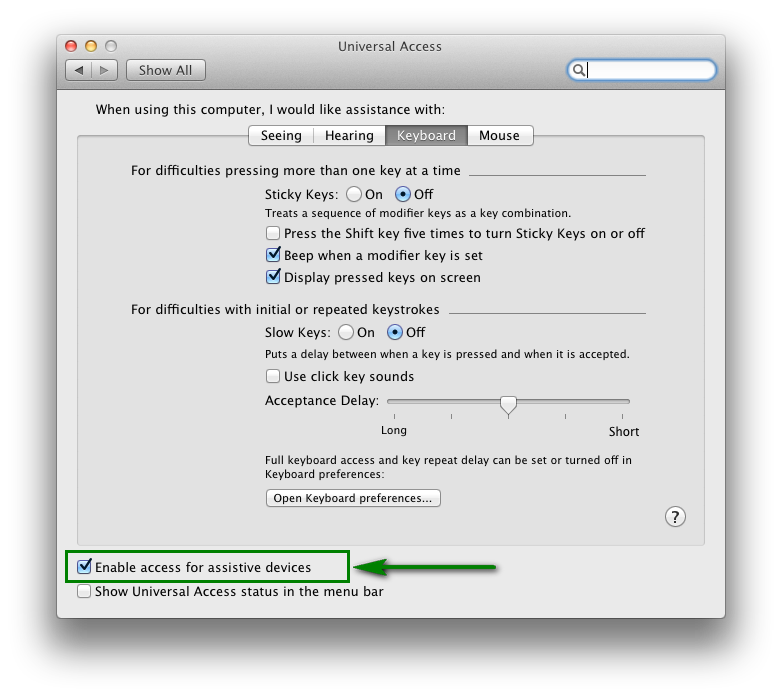
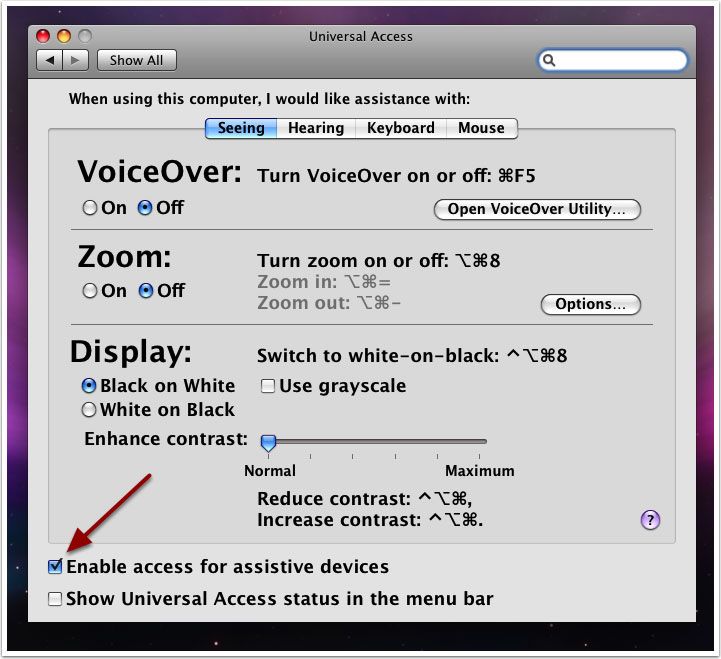
Sorry about that...
I figured out it would even be better to change that into:
sudo echo -n 'a' > /private/var/db/.AccessibilityAPIEnabled
sudo chmod 444 /private/var/db/.AccessibilityAPIEnabled
Not using the -n would leave an 'a' followed by a 'newline' inside the file instead of just the 'a'
Assistive Devices For Reaching
It is useful to point out that System Preferences should not be open during this procedure. I discovered this while debugging a script that used the aforementioned code while I had the Accessibility prefpane open.
In Snow leopard I find that this does not work. It creates the hidden file, places the 'a' within, and in system preferences the 'enable access for...' is checked, but my applescripts still say 'access for assistive devices is disabled'. Only once I manually check the checkbox do the scripts work. This leads me to believe that something else, other than the .AccessibilityAPIEnabled file is happening under Snow Leopard.
My whole goal is to have a window/app management script that launches and places all of my startup apps/windows for dual monitors. I despise the automated mouse movement that comes with 'access for assistive devices' but I need this to move and resize the windows so in a single applescript i want to:
1. turn the access on
2. move and place the windows
3. turn the access off